



You love Grok Bot but you also love Hermes. You use Grok Bot but you also use Hermes. You want to run your Hermes agent alongside your Grok Bots so it answers to your chief of staff bot, collaborates with other bots, and participates in the group chat with all your Grok Bots. Can it be done? Yes!
Hermes is great!
Even though I love Grok Bot, and use it for much of my agentic work nowadays, for some things, I still prefer a Hermes agent. My Hermes agent isn't relegated to insignificant tasks either. My first always on, agentic assistant was Hermes, and it just so happens that it's still one of my most important agents. My Hermes agent is Charlotte, my homeschool agent. Charlotte helps me with all of the administrative work of homeschooling my children. She helps our family log and track: time, the books we read, and schoolwork. She also helps us follow Ambleside Online artist and composer rotations. She generates educational content that she pushes to my oldest daughter's tablet lock screen, and she makes sure the music, images, and messages on my daughter's alarm clock, relate to what we're doing in school. And she does a lot more too!
In this case, replacing Hermes with Grok Bot is a tall order. Charlotte runs lots of jobs on my local computer and over my local network. She connects to devices on my local network, and she does things fully autonomously. She edits files locally, and I want these files to be local. Yes, Grok Bot can do most of this in some capacity, but doing all of it seamlessly? This hasn't been the case for me. One of the main reasons for this is Grok Bot's routines vs. the cron jobs that Hermes runs. Hermes' jobs run autonomously in the background but Grok Bot routines require approval. Also, Grok Bot, tends to want to use its own computer, which is a huge strength for lots of things, but not so much for what I want out of my homeschool agent.
Grok Bot is great!
On the flip side, I use my Grok Bots for everything from software engineering and product management, to video creation and helping with radio communications. But I'm also running a business that has a lot of crossover with homeschooling because I create educational products that I use with my own family in our homeschooling. This includes, my Hermes homeschooling agent Charlotte herself, since I open sourced her through the company. So, it makes sense that I would want her to be involved in aspects of the business. I need her to test the agent product integrations we develop to make sure they'll work in our homeschool, and help frame product decisions pedagogically. Sometimes I want her input on content. So, I want Charlotte, my Hermes agent, to collaborate with my Grok Bots.
One of the things that make Grok Bots so great, is that they can work together. You can have a software engineer bot, marketing bot, video creator bot, app store specialist bot, all managed by a chief of staff bot. Your bots take orders from the chief of staff and can collaborate with you in a group chat. For MindFeast, I run a setup similar to this, and it's fantastic. I wanted my Hermes agent to be part of it.
What didn't work?
In the beginning, I tried doing this by simply running Charlotte in two places at once. I let her run continuously as a Hermes agent, all of her jobs running 24/7, but also spun her up as a Grok Bot. I figured this way, I could have the best of both worlds. Hermes Charlotte would continue to do all the things I wanted her to do, and I could still talk to Grok Bot Charlotte, which would have access to the same directories and skills, and would be capable of the same tasks. It sounded good in theory but failed in practice.
In practice, Hermes Charlotte did fine, but when I talked to Grok Bot Charlotte, it was like talking to a different agent, and when I asked her to do tasks that she should have been capable of, she would come up short. She would do them, but she would often be missing context. I'm pretty sure I could have fine tuned things to getting everything working perfectly, but I would have needed to recreate rules and routines in Grok Bot that already existed in Hermes, and I would have had to build in some more deterministic behavior around working with my local files.
None of this is to say, that Charlotte couldn't run fine as a Grok Bot. If she were to be set up as a Grok Bot, and always run as a Grok Bot, I think Charlotte could work quite well for someone, however, I run her in a very particular way and I have her running some pretty advanced workflows. So, what could I do?
Running a Hermes agent as part of a Grok Bot fleet
Hermes has an API that runs on localhost. The API can start a run, stream its events, poll its status, and answer approvals. It exposes nearly the full CLI toolset (terminal, files, browser, image generation, delegation, plus the agent's MCP tools), so local workflows work through it. Memory and skills are shared across every Hermes surface and API conversations are their own sessions. In other words, contacting Hermes through the API, is very similar to contacting it through something like Telegram. It's just another entry point.
To get Hermes running as part of my Grok Bot fleet, all I needed to do was get a Grok Bot to funnel all requests to the API and back. Like most things in the days of agents, this was not difficult. I directed my chief of staff Grok Bot to do this with the existing Grok Charlotte after discussing my reasons for doing it and the results I was looking for. My chief of staff bot, simply wrote a script to interact with the Hermes API and saved it on my local computer. He then updated Charlotte's profile with instructions to always use the API script for everything. Then we just tested and iterated until it worked how I wanted. I added a /new command, to make it start a new session. This is how Hermes works with Telegram, and seemed like it was something I should be able to do in Grok Bot. Adding it, was as simple as saying in Charlotte Grok's instructions that a new session should be activated when /new is used.
Another thing I added was a proof of work footer to all of the responses that come from Hermes. This just means that Charlotte's replies in Grok bot have a little markdown footer attached that shows the model and version used in Hermes, and how many tool calls were made, etc. This provenance gives confidence and allows me to know for sure that the responses are coming from Hermes and not the Grok Bot itself. Also, our script supports per-instance profiles, so I can onboard other Hermes agents if I want to use more of them with my Grok Bots in the future. There's at least one more I might do this with.
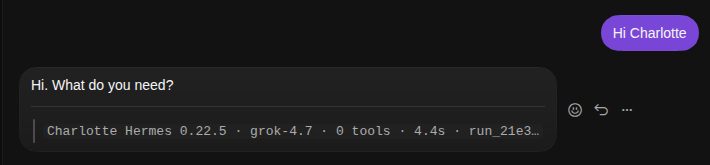
Another way to think of this, is that I turned my Charlotte Grok Bot into an API calling shell, or a simple front-end to Hermes. I'm not sure that this was the best way to achieve what I wanted, and it's obviously not as good as a true collaboration between @poteto and @Teknium would be, if Grok Bot had an API and they were to team up to build an official way of running a Hermes agent as part of a Grok Bot fleet, however, I can say this is working very well for me at the moment. My Hermes homeschool agent sits with my Grok Bots, it takes orders from my chief of staff bot, and participates in the group chat with all of us. When it responds, I can tell the responses are coming from Hermes, and jobs I delegate to this Grok Bot, are in turn delegated to Hermes and completed in the same fashion I expect from Hermes. In essence, I turned Grok Bot into a poor man's entry point for Hermes, and it's working well so far.